
Introduction
When you first begin your journey to Korea, the very first thing you’ll encounter is the transportation system. Many travelers find themselves worried about which mode of transport to take from the airport into the city.
But don't you worry! In this post, I’ll walk you through everything in detail. So, take a deep breath, relax, and enjoy the read—we’ve got you covered.
At the Airport - Your Gateway to Korea (Incheon & Busan)
The moment you step off the plane, your Korean adventure truly begins. Depending on whether you land in Incheon or Busan, your first impression might differ slightly, but both offer world-class efficiency.
1. Incheon International Airport (ICN)
As Korea’s main hub and one of the best airports in the world, Incheon is vast and high-tech.
- Smart Pass: Incheon utilizes a "Smart Pass" system (facial recognition). While mainly for departures, having the app ready and your information registered makes navigating the airport much smoother.
- Check Your Terminal: Incheon has two main terminals (T1 and T2). Make sure you know which one your airline uses. They are connected by a free shuttle bus, but it takes about 15–20 minutes to travel between them.
2. Busan Gimhae International Airport (PUS)
If you are heading straight to the beautiful beaches of Busan or the historic sites of Gyeongju, you’ll likely land here.
- Compact & Fast: Compared to Incheon, Gimhae is much smaller. The biggest advantage? You can get from the gate, through immigration, and out to the city much faster because of the shorter walking distances.
- A Relaxed Start: It’s generally less crowded than Incheon, offering a more peaceful and laid-back introduction to Korea.
e-Arrival Card & Q-code: By 2026, paper forms are largely a thing of the past. Ensure you register your health information via Q-code and fill out your e-Arrival Card online before you land. This allows you to pass through checkpoints with a simple QR scan.
Immigration (Foreigner Lane): While Korean citizens use automated gates, visitors should head to the "Foreigner" lanes. You’ll be asked to present your passport and provide digital fingerprints and a photo. The officers are professional and usually speak English, so there’s no need to be nervous!
Simplified Customs: If you have nothing to declare, you don't need to fill out a paper form anymore. After picking up your luggage, simply follow the Green Line (Nothing to Declare) to exit into the arrival hall.

How to Pay for Public Transport
Before heading into the city, you’re likely wondering: "Do I need to exchange cash? Should I buy a local transit card?"
You’ve probably seen many tourists lining up to get a physical transit card before hitting the subway. But here’s a pro tip: Did you know you can pay for Korean subways and buses simply by tapping your Mastercard or Visa?
While countries like China rely heavily on QR code pay systems, South Korea’s public transport is 100% integrated with Contactless Credit and Debit Cards. If your card has the contactless symbol (the sideways Wi-Fi icon), you’re good to go! If you don't have one yet, we highly recommend getting a contactless Mastercard or Visa for the ultimate convenience during your stay.
Why You Should Use a Card (The Magic of Transfers)
In Korea, the transit system is incredibly smart. When you switch from Subway to Bus or Bus to Bus, you receive a Transfer Discount. In most cases, the transfer is effectively free (or costs a tiny fraction of a dollar).
Because of this highly efficient system, we strongly recommend using your Contactless Card rather than buying a Day Pass. Unless you plan on taking the subway more than 10 times a day, using a standard card is much more economical and flexible.
Heading into the City: Transportation Guide
Once you’ve cleared customs, it’s time to head to your accommodation. Depending on your destination, here are the best ways to get from the airport to the city.
1. From Incheon Airport to Seoul
Seoul is about an hour away, and you have two excellent rail options plus a premium bus service.
- AREX (Airport Railroad Express):
- Express Train: This is a non-stop train from Incheon Airport to Seoul Station (approx. 43–51 mins). It features reserved seating and dedicated luggage racks, making it the most comfortable choice for travelers with heavy bags.
- All-stop Train: This stops at every station along the way. If your hotel is near Hongdae (Hongik Univ. Station) or Digital Media City, this is faster and cheaper than the Express train.
- Airport Limousine Bus:
- If you don't want to carry your luggage through subway transfers, this is your best bet. These buses go to major districts like Gangnam, Myeongdong, and Jamsil, often dropping you off right in front of major hotels.

http://www.seoulmetro.co.kr/download/map_english.jpg
you can donwload Seoul metromap from above goverment official link.
2. From Gimhae Airport to Busan
Gimhae Airport is relatively close to the city center, making the commute quick and easy.
- Busan-Gimhae Light Rail: The most reliable way to beat traffic. Take the Light Rail to Sasang Station (to transfer to Line 2 for Seomyeon or Haeundae) or Daejeo Station (for Line 3).
- Airport Limousine Bus: Direct routes to Haeundae and Busan Station. It’s more comfortable than the rail system if you have multiple suitcases.
A Friendly Warning: Avoid Local City Buses with Luggage
While local city buses are the cheapest option, we strongly recommend NOT taking them if you have large suitcases. Space is limited: Unlike Airport Limousines, local buses do not have luggage compartments.
- Crowded conditions: Narrow aisles and high passenger volume make it very difficult (and sometimes stressful) to maneuver with bags. Stick to the AREX, Light Rail, or Limousine Buses for a much smoother start to your trip!

https://www.humetro.busan.kr/homepage/cyberstation/mapeng.do
Cyber Station
www.humetro.busan.kr
you can check Busan metromap from above goverment official link
Was the content so far informative? It's not over yet. Now, the taxi ride begins. : )
Navigating Taxis in Korea: Rules and Tips
At the Airport: Use the Designated Taxi Stand
Before we dive into the app, there is one important rule at the airport: You cannot call a "Call Taxi" (like Kakao T or Uber) via an app while you are at the airport arrival area.
Just like in many other countries, airport taxis wait in a long queue for hours to pick up passengers. Therefore, the only way to get a taxi from the airport is to head to the designated Taxi Zone and take the next one in line. Don't worry, these airport taxis are strictly regulated, so you can feel safe!
In the City: Why You Should Use "Kakao T"
Once you are in the city, you might encounter a few challenges. While most drivers are honest, some may still try to negotiate the price (haggling) or take a longer route with foreign tourists. To prevent these issues and ensure a smooth ride, we highly recommend using the Kakao T app.
Why use Kakao T?
- Prevent Overcharging: The app provides an estimated fare before you call the taxi. The route is tracked via GPS, so there’s no need to worry about the driver taking a detour.
- No Communication Barrier: You enter your destination in the app (which supports English). The driver receives the exact location on their navigation system, so you don't have to explain your destination in Korean.
- Transparent Pricing: The fare is calculated by the meter, or automatically charged to your registered card, ensuring a fair price every time.
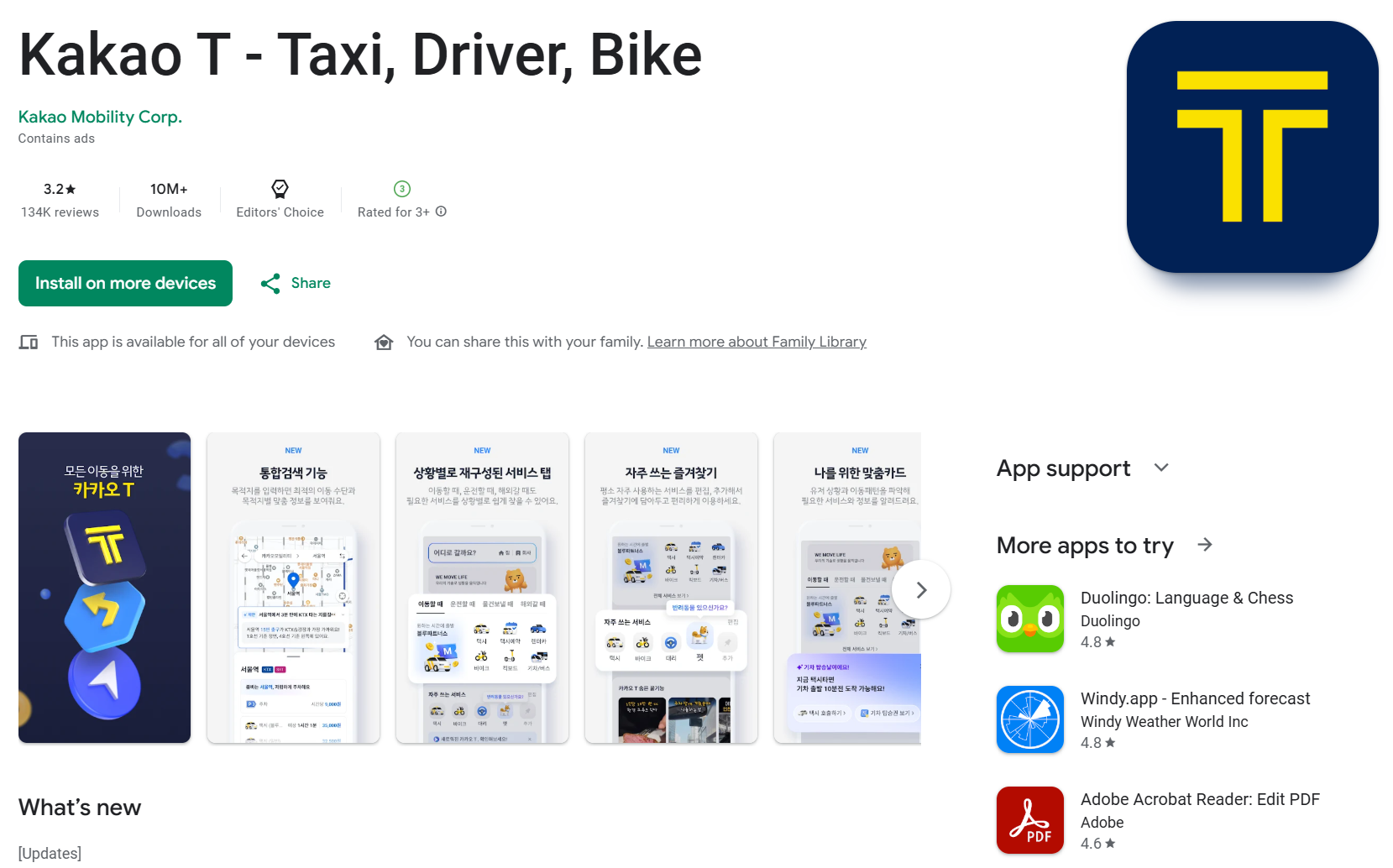
https://play.google.com/store/apps/details?id=com.kakao.taxi&hl=en
Kakao T - Taxi, Driver, Bike - Apps on Google Play
The app for every mobility services
play.google.com
1. Sign-up and Language Settings
- Seamless Language Support: Once installed, the app automatically suggests English, Japanese, or Chinese based on your phone's system language settings. This allows you to search for destinations and call a taxi even if you don't speak a word of Korean.
- Identity Verification: In the past, a Korean phone number was mandatory. However, you can now sign up and verify your identity using an international phone number, making it accessible to tourists immediately upon arrival.
2. Payment Methods (The Biggest Change!)
- Register International Cards: Previously, only Korean credit cards could be registered, preventing foreigners from using "Automatic Payment." Now, you can link foreign-issued Mastercard or Visa cards directly. The fare is automatically charged when you arrive, so you can simply hop out without any extra steps.
- Pay to the Driver: If you prefer not to register a card, you can select the "Pay to the driver" option. When you reach your destination, you can pay using cash or a Contactless Card (Mastercard/Visa) as mentioned earlier.
3. Benefits and Convenience
- Estimated Fare Guidance: The app provides an estimated fare before you even call the taxi. This eliminates any anxiety regarding overcharging or "haggling."
- Easy Communication: Since you input your destination into the app, there is no need to struggle with broken Korean to explain where you are going. Your driver will already have the exact route loaded onto their navigation system.
It is not over yet. The next topic, the final one regarding transportation, is trains.
Two Train station in Seoul (Seoul Station and Suseo Station)
If you’re traveling in Korea for the first time, one thing that can be surprisingly confusing is this.
Seoul Station vs Suseo Station
At first, they might sound like similar places, but they are actually very different.
Seoul Station (KTX - Public corporation)
Seoul Station is the main train hub in the city. This is where most travelers go when taking the KTX.
- KTX trains depart from here
- Direct connection to the airport (AREX)
- Easy access via subway lines
- Very foreigner-friendly
https://www.korail.com/global/eng/main
코레일
한국철도공사, 코레일, 승차권 예매, 기차여행상품, 운행정보 안내
www.korail.com
you can check KTX ticket reservation page from official link
Suseo Station (SRT - Private company)
Suseo Station is a different type of station. It is used for SRT trains, not KTX.
- SRT trains depart from here
- Located in the Gangnam area
- Usually less crowded
- Sometimes slightly cheaper
https://etk.srail.kr/main.do?language=EN
영문승차권 예약/발매 - SR
Select departure station Select an arrival station Select time After 00 After 02 After 04 After 06 After 08 After 10 After 12 After 14 After 16 After 18 After 20 After 22 Select Adults Adult 0 Adult 1 Adult 2 Adult 3 Adult 4 Adult 5 Adult 6 Adult 7 Adult 8
etk.srail.kr
you can check SRT ticket reservation page from official link
Busan Station (KTX&SRT)
Fortunately, both KTX and SRT trains arrive at Busan Station. No matter which station you depart from in Seoul, you will arrive at Busan Station. However, when traveling from Busan back to Seoul, your arrival station will differ depending on whether you take the KTX or SRT.
Today, I talked about the first transportation you’ll experience when traveling in Korea. Hope this helped you! 😊

댓글